
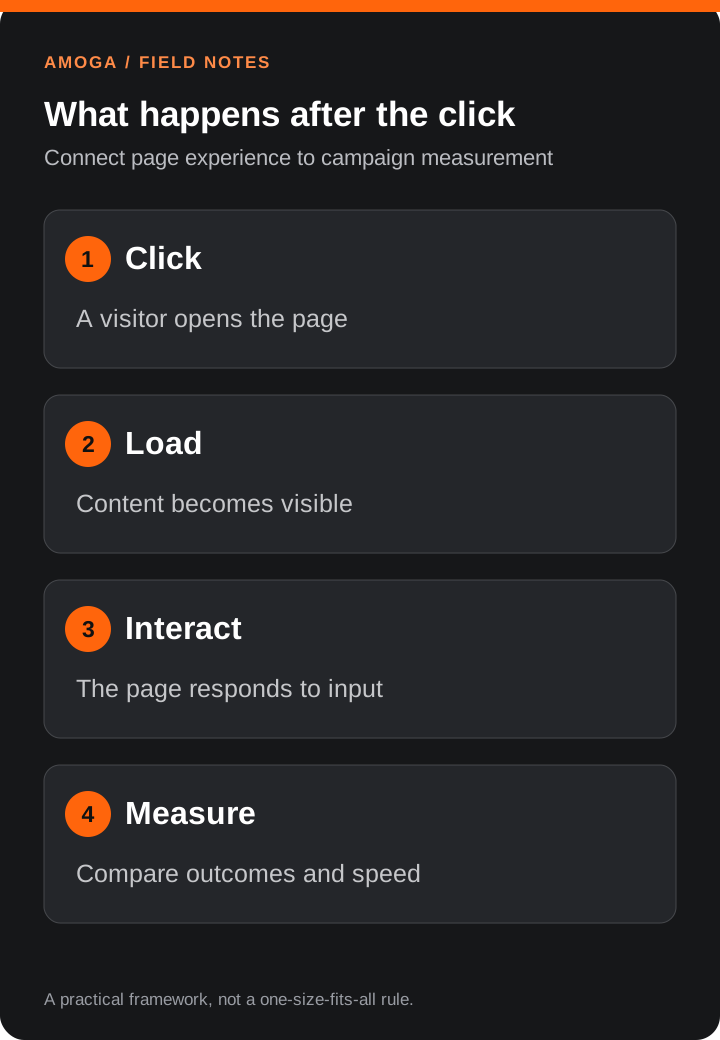
What happens after the click
If someone clicks an ad and the landing page is slow or hard to use, they may leave before seeing the offer. Page speed is one part of the experience alongside relevance, content, and the offer itself.
Faster landing pages can make paid campaigns more effective by helping visitors reach the content they came to see. The effect depends on the campaign, audience, and page.
Start by measuring the page on the devices and networks your visitors actually use.
1. Measure the journey
Compare ad clicks with landing page visits and subsequent actions. Break the data down by device and connection where possible, and investigate gaps before assuming speed is the cause. Analytics and ad platforms count events differently, so check their definitions too.
2. Why Traditional CMS & Client-Side SPAs Fail Mobile Traffic
Most marketing websites are built on either legacy monolithic CMSs (WordPress, Drupal) or bloated client-side Single Page Applications (React, Next.js client hydration).
Both architectures suffer from fatal mobile bottlenecks:
- Monolithic Server Response Delay: Traditional servers must run database queries, execute dozens of third-party plugins, and assemble HTML on the fly, resulting in a sluggish Time to First Byte (TTFB > 800ms).
- The JavaScript Hydration Trap: Client-side SPAs send empty HTML followed by a 2MB bundle of JavaScript. On a mid-tier smartphone over a 4G connection, the mobile CPU spends 2.5 seconds parsing and executing JavaScript before a single button can be clicked.
The Modern Sub-Second Edge Solution
At Amoga, we utilize Astro Static Generation with Global Edge Distribution:
- 100% of landing page markup, CSS, and critical assets are pre-rendered at build time.
- Static assets are distributed across hundreds of global edge nodes (Cloudflare / Fastly), ensuring sub-50ms TTFB worldwide.
- JavaScript is strictly confined to isolated interactive widgets, meaning zero main-thread CPU blocking on page load.
3. The Three Core Web Vitals That Drive Conversion Velocity
Google and modern browsers track three core user-centric performance metrics. Optimizing these metrics is directly correlated with higher conversion rates:
- Largest Contentful Paint (LCP < 0.8s): The main headline, hero visual, and primary CTA must render in less than 800 milliseconds.
- Interaction to Next Paint (INP < 40ms): Every form input, dropdown, and CTA button must respond with immediate tactile feedback, eliminating hesitation.
- Cumulative Layout Shift (CLS = 0.00): Zero visual jumping or delayed banner popping that causes users to mis-click or lose their place.
4. Edge Asset Optimization & Smart Resource Prioritization
Achieving sub-second performance requires relentless discipline in how browser network resources are prioritized:
- Prioritise essential styles: Deliver the styles needed for the first visible part of the page promptly.
- Use appropriately sized images: Choose efficient formats and responsive image sizes, then compare image quality and file size.
- Third-Party Script Sandboxing & Web Worker Offloading: Moving marketing tags (Google Tag Manager, Meta Pixel, Hotjar) off the main UI thread into background Web Workers via PartyTown, preventing tracking scripts from degrading user interaction speed.
Review the scripts on a campaign page and remove those that are not needed. Some third-party work can be moved away from the main thread, but compatibility varies; test tracking and page interactions before and after any change.
The Executive Speed & ROAS Audit Checklist
Before you increase your monthly media budget, run your high-converting landing pages through this performance verification checklist:
- Time to First Byte (TTFB) is under 50ms across global testing regions.
- Largest Contentful Paint (LCP) is under 800ms on simulated mobile 4G connections.
- Third-party tracking scripts and pixels are offloaded from the main thread via Web Workers.
- Zero-JS architecture delivers pure pre-rendered HTML with 0ms hydration delay.
- Cumulative Layout Shift (CLS) is verified at 0.00 across all responsive breakpoints.
Summary & Next Steps
Treat performance as part of the visitor experience and measure its impact alongside the other factors in your campaign.
If you want to review the performance of your landing pages, get in touch.