
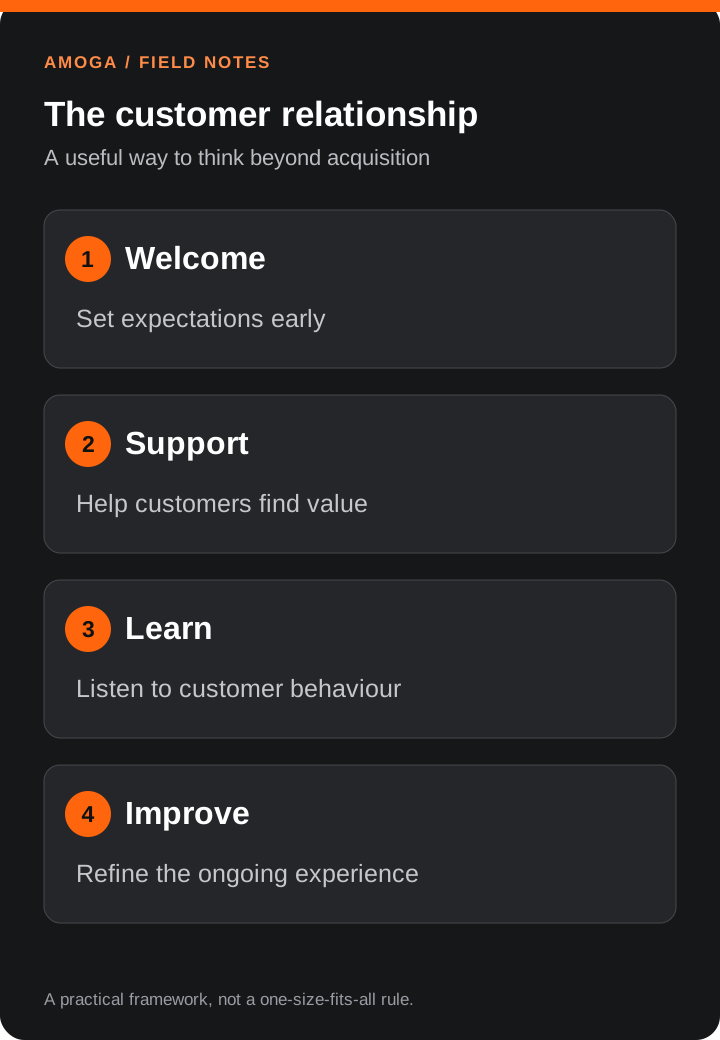
The Acquisition Trap: Why Single-Transaction Brands Die
In the modern digital economy, Customer Acquisition Costs (CAC) across paid advertising channels increase by 15% to 25% year over year. Ad inventory is crowded, attribution tracking has become obfuscated, and bidding wars compress front-end margins.
Brands that treat the initial checkout or deal signature as the “finish line” find themselves trapped on a treadmill: they acquire a customer at break-even (or at a loss), deliver the product or service, and immediately must pay full market price again to acquire the next transaction.
The most profitable, defensible businesses in the world do not make their fortunes on the initial acquisition. They make their fortunes on the compound yield of their retention engine—maximizing Customer Lifetime Value (LTV) while marginal CAC drops to zero.
Repeat purchases can improve customer lifetime value and change how much a business can afford to spend acquiring customers. The effect depends on margins, purchasing frequency, and retention costs.
Here are several ways to make the experience after purchase more useful to customers.
1. Post-Purchase Cognitive Alignment & Buyer Remorse Elimination
The 72 hours immediately following a high-stake transaction represent the highest vulnerability window in the customer relationship. This is when post-purchase anxiety and buyer’s remorse spike.
After a purchase, customers benefit from knowing what happens next. A clear confirmation and useful onboarding can reduce uncertainty; follow-up purchases depend on the product, the customer, and their experience.
The Immediate Post-Purchase Protocol
- The Instant Founder Welcome Video: Embedded directly on the order confirmation screen, explicitly outlining the exact timeline of what happens next.
- Value-Affirmation Email Sequence (Days 1–3): Delivering zero up-sells. Focus 100% of communication on celebrating their decision, sharing quick-win tutorials, and establishing direct VIP support channels.
- Frictionless Unboxing / Onboarding Flow: Removing any technical or psychological hurdles required for the customer to experience their first core moment of value (“Time-to-Value < 24 hours”).
2. Behavioral Event Triggers vs Static Time Blasts
Traditional marketing sends generic broadcast emails every Tuesday at 10 AM to the entire contact list. These static blasts result in high unsubscribe rates and low click-through rates.
Modern retention architecture operates on Dynamic Behavioral Event Triggers:
- Predictive Replenishment Windows: For consumable or cyclical products, calculate the customer’s individual consumption velocity and trigger an automated SMS/email 5 days before replenishment is required.
- Milestone & Achievement Gamification: Congratulating customers when they achieve specific usage thresholds (e.g., 10,000 requests processed, 30 days active) paired with an exclusive tier upgrade.
- Early Churn Warning Interventions: When a customer’s login frequency, app activity, or order interval drops below 40% of their historical baseline, the system automatically triggers a personalized concierge check-in before churn occurs.
3. Give returning customers a reason to stay
Loyalty tiers can give returning customers benefits that reflect how they engage with your business:
- Member: Standard order tracking and access to customer support.
- Returning customer: Benefits such as early access to a new release.
- High-value customer: More personalised support where it makes sense for the business.
The right benefits depend on what customers value and what your business can deliver consistently. Measure repeat purchases and customer feedback before deciding whether a loyalty programme is worthwhile.
4. Cohort LTV Analytics & Decay Modeling
You cannot optimize what you do not measure with mathematical precision. High-growth retention requires deep Cohort Analysis:
- 30/60/90/180-Day Cumulative LTV: Measuring exact net revenue generated by each customer cohort relative to their initial acquisition CAC.
- Product Pathway Affinity: Identifying which initial entry product or service creates the highest 12-month retention rate (and shifting top-of-funnel ad spend to acquire buyers into that specific entry gateway).
- Net Revenue Retention (NRR): Ensuring expansion revenue from existing accounts outpaces natural customer attrition (targeting NRR > 120% for enterprise B2B).
The Executive Retention Engine Checklist
Before you allocate additional budget to customer acquisition, audit your retention mechanics against these core benchmarks:
- Dedicated white-glove onboarding and value affirmation sequence activated immediately post-purchase.
- Dynamic behavioral triggers deployed for predictive replenishment and milestone celebrations.
- Tiered VIP status architecture providing tangible commercial and psychological incentives for repeat business.
- Early churn intervention protocols in place to flag and rescue disengaging accounts automatically.
- Real-time cohort LTV telemetry tracking 30/60/90/180-day revenue expansion across all marketing channels.
Summary & Next Steps
Customer acquisition buys you market attention; retention architecture builds you an enterprise empire. When your existing customers happily buy more often and stay longer, your business becomes economically unstoppable.
If you want help improving the experience after purchase, get in touch.