
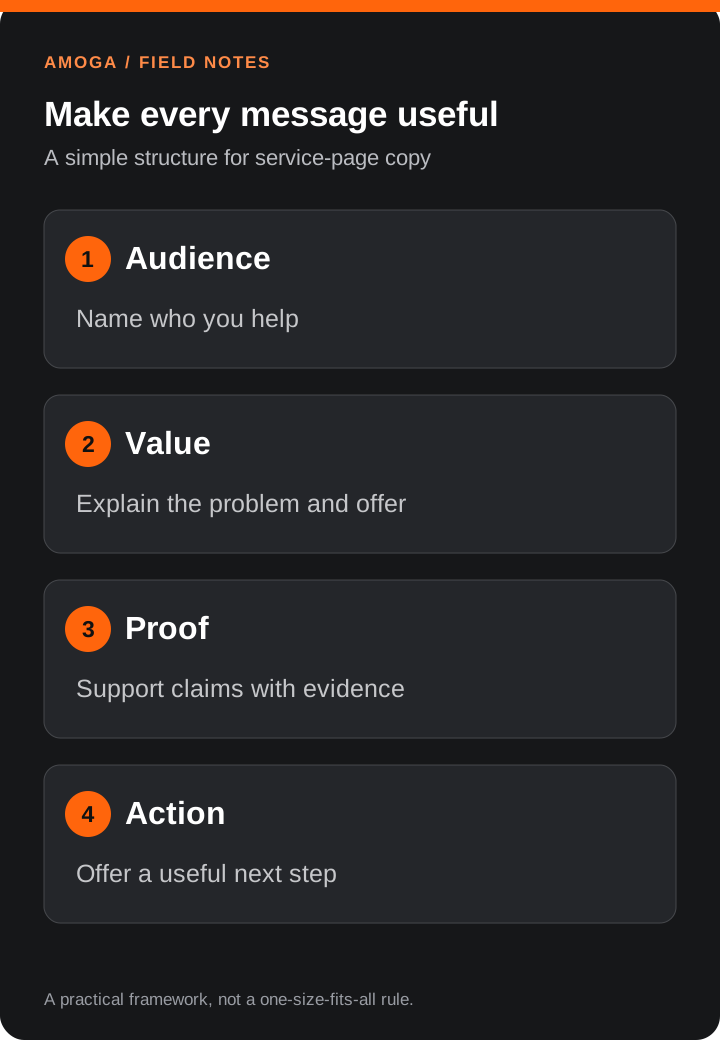
Start with what the reader needs to know
Many B2B websites rely on phrases that say little about the service:
- “Empowering seamless synergy for modern enterprises.”
- “The all-in-one digital transformation platform.”
- “Unlocking innovative agility through data-driven intelligence.”
Readers should be able to understand what you offer, who it helps, and what to do next. Specific evidence helps when you have it; it should never be invented to make a headline sound stronger.
1. The Value-Proof-Action (VPA) Architecture
One useful way to review a section is to check its value, evidence, and next step:
- Value: What do you offer, who is it for, and what problem does it address?
- Proof: What relevant evidence can help the reader evaluate your claim?
- Action: What useful next step can the reader take?
An Example Transformation
- Vague / Low-Converting: “We build fast websites for modern companies.”
- More specific: “We design and build websites for B2B teams. Tell us about your project to discuss scope and timing.”
The clearer version gives the reader a concrete service and a next step without relying on invented results.
2. The 3-Layer Headline Mechanics
A high-converting hero section never relies on a single standalone sentence. It deploys a coordinated 3-Layer Headline Hierarchy:
- A clear category: A short phrase that helps visitors understand the type of service you offer.
- The Transformational Display Headline: A bold, high-contrast Satoshi display title that articulates the core commercial transition (e.g., “Transform Sluggish Monoliths Into Sub-Second Inbound Engines”).
- The Executive Sub-Headline Standfirst: A 2-sentence explanatory paragraph addressing the specific mechanism, target ICP, and primary outcome without unnecessary buzzwords.
3. Systematic Objection Preemption
Enterprise buyers do not reject offers because they dislike the features; they reject offers because they perceive unaddressed risks.
Top-performing conversion copy anticipates every hidden objection and systematically preempts it before the buyer even has the chance to voice it:
- Objection: “Migrating our platform will cause weeks of costly downtime.”
- Preemptive Copy: “Zero-Downtime Blue-Green Cutover. We migrate your entire architecture in parallel, ensuring 100.0% uptime and seamless DNS transition.”
- Objection: “We don’t want to get trapped in another long agency contract.”
- Preemptive Copy: “Transparent Fixed-Scope Sprints. Clear milestones, weekly code handoffs, and 100% intellectual property ownership from Day 1.”
- Objection: “Our internal developers won’t know how to maintain custom code.”
- Preemptive Copy: “Complete Documentation & Team Handover. We provide full TypeScript architectural docs and 30 days of direct engineer-to-engineer pair programming.”
4. Friction Reduction in Calls-to-Action (CTA Micro-Copy)
The primary reason qualified enterprise prospects abandon a lead form is the anxiety of what happens after they click submit.
Standard forms display a generic button that says “Submit” or “Contact Us”, which subconsciously signals: “Prepare to be spammed by aggressive SDRs for the next three weeks.”
High-converting CTA micro-copy replaces ambiguity with total transparency:
For example, a button labelled “Discuss your project” could be followed by a short explanation of what happens next, such as when the team usually replies. Only promise a process you actually provide.
Clear expectations can make a form feel easier to complete. Test changes against your own audience rather than assuming a particular lift.
The Executive Conversion Copy Audit Checklist
Before launching your next landing page or marketing campaign, audit your messaging against these critical conversion rules:
- Value-Proof-Action (VPA) hierarchy present on every core proposition card.
- Zero corporate buzzwords (“empower”, “synergy”, “paradigm”, “all-in-one”) in headlines.
- Quantitative metrics and timeframes attached to all key outcome claims.
- Major buyer objections explicitly answered and preempted directly adjacent to CTAs.
- Post-submission protocol clearly stated directly beneath form submit buttons.
Summary & Next Steps
Great conversion copywriting is not an art of decoration; it is the science of clarity and risk de-escalation. When you speak to your customers with absolute precision and undeniable proof, conversion becomes the natural, inevitable outcome.
If your website is hard to explain in a sentence, start by revisiting the offer and the audience it serves.