
People researching a service might start with Google, ask an AI assistant for options, visit agency websites and compare recommendations before contacting anyone. Your website should help them understand what you do and decide whether you are a good fit at each step.
AI search optimisation is often called AEO or GEO. The terms describe efforts to make content useful and understandable to answer systems. They do not describe a guaranteed route to a citation. Google’s guidance for AI features emphasises the same foundations as search more broadly: accessible pages and helpful, distinctive content.
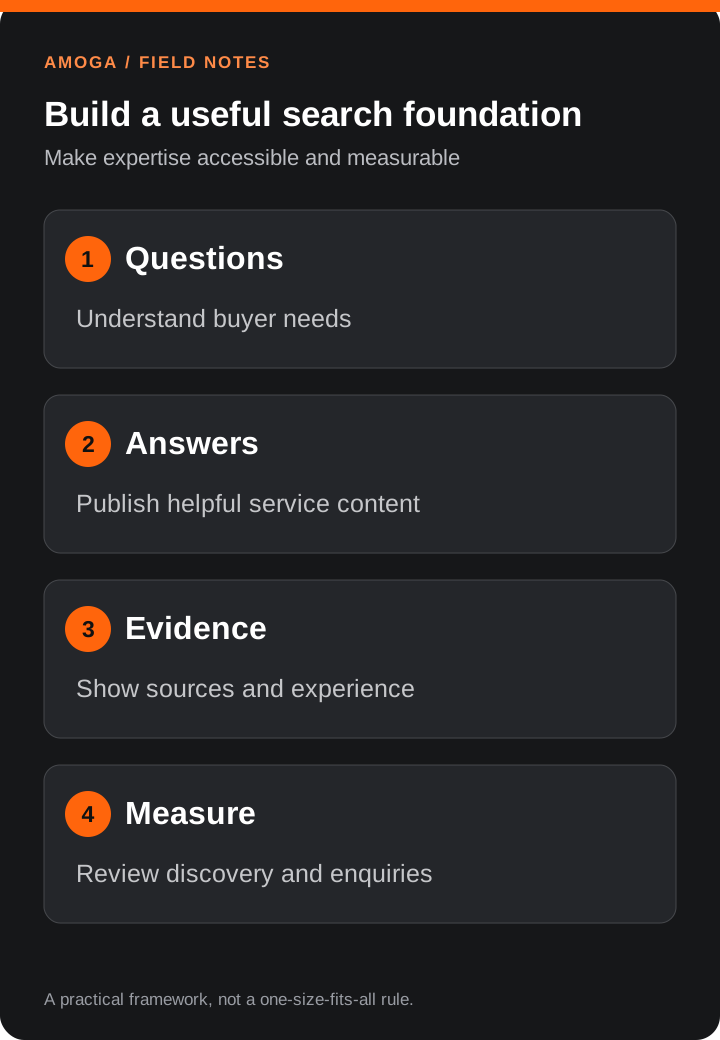
Start with the questions buyers actually ask
List the questions that arise during sales calls and project delivery. Group them by the decision a reader is trying to make: understanding a problem, comparing approaches, choosing a provider or preparing a project.
For a website design agency, useful questions might include:
- What should a B2B website redesign include?
- How do we know whether our current site is losing enquiries?
- Should we improve an existing site or rebuild it?
- What affects the cost and timeline of a website project?
- How do we preserve search traffic during a migration?
Each question deserves an answer when you have something useful to add. Closely related questions can live on one comprehensive page; creating dozens of near-identical pages for small wording variations makes the site harder to maintain and does not guarantee visibility.
Give every core service a clear home
A service page should explain who the service is for, the problem it addresses, what the work includes and what a client can expect next. Use the language a prospective customer would use, but write naturally. A page about website design can use that phrase in its title and heading without repeating it in every paragraph.
Connect supporting articles to the relevant service. For example, a guide about planning a redesign can link to your website design service. The service page can link back to useful guides, helping readers continue their research and giving search crawlers clear paths through the site.
Add evidence a reader can evaluate
Specificity builds trust. Describe the decisions behind a project, the constraints you encountered and what changed. When sharing a result, explain the metric, the time period, the starting point and any limitations. Do not publish a percentage or performance claim unless you can substantiate it.
An author name, a meaningful agency profile and clear contact information also help readers assess the source. Link to an actual author profile when one exists. Avoid invented credentials, stock portraits presented as real people, or schema references to social profiles that have not been verified.
Make the site technically accessible
Search engines need to discover and access your content. Check that important pages return a successful response, are linked from other pages, have a suitable canonical URL and are not accidentally blocked from indexing. Submit a sitemap through Google Search Console and investigate pages that remain unindexed.
Give each page a descriptive title and a concise meta description. Make headings reflect the content, use meaningful link text and include useful image descriptions where the image contributes information. Images should load at appropriate sizes without pushing the article around as the page loads.
Structured data can help search engines interpret information already visible on the page. For articles, Google’s Article structured data documentation describes properties such as headline, author, image and publication date. Markup is not a promise of a particular search appearance or AI citation.
Write answers that stand on their own
Start with a direct explanation, then provide the detail needed to act: a comparison, a worked example, a checklist or the trade-offs behind a decision. Use headings that help people scan. A table is useful when it makes a comparison clearer; it is not inherently better than prose.
When discussing a tool, regulation or platform feature that can change, link to a reliable source and revisit the page periodically. Separate observed results from estimates. If you do not have evidence for a claim, say so or leave it out.
Measure the full journey
Use Search Console to monitor impressions, clicks and the queries that surface relevant pages. Look at trends by page and topic, not just a single keyword position. Analytics can show whether readers continue to a service page or submit an enquiry, provided measurement is configured appropriately and respects applicable consent requirements.
For AI assistants, manual checks can reveal how a brand appears for a small set of representative questions, but responses vary by product, location and time. Record the prompt, date and source links; treat the result as a sample, not a complete ranking report.
Review business outcomes too: qualified enquiries, sales conversations and customer feedback. A page that gets modest traffic but answers an important buyer question may still be valuable.
A practical first month
- Inventory your service pages and existing articles. Identify outdated claims, overlapping topics and broken links.
- Select a small group of buyer questions for each service, using sales conversations and Search Console data where available.
- Improve the core service pages, then publish supporting guides with useful examples and links between them.
- Check indexing, mobile usability, image delivery and article metadata.
- Record a baseline and revisit the content after you have enough data to assess it.
No agency can promise a first-page Google ranking. Competition, site quality, relevance and many other factors affect results. The controllable work is to create a credible resource, make it accessible and keep improving it based on evidence.
For help with your website’s structure and content foundation, explore our website design services.